Monday, March 21, 2011

The Dumbing Down of Everything

http://www.ncregister.com/blog/the-dumbing-down-of-everything?utm_source=feedburner&utm_medium=feed&utm_campaign=Feed%3A+NCRegisterDailyBlog+%2540National+Catholic+Register%2541#When:03:15:20Z

The National Catholic Register

 Friday, March 18, 2011 11:15 PM Comments (35)
It is somehow fitting for the oxymoronic age in which we live that we call the uniform distribution of mediocrity, progress.
Anyone who has ever had the good fortune to watch Ken Burns’ documentary on the Civil War cannot help but be taken aback by the simple eloquence of men of little formal education and the surpassing eloquence of some of the educated.
Illiteracy was widespread 150 years ago.  Yet, those who were literate, even with just a fourth grade education, had such a facility with words that this blogger is put to shame.
Take for instance the letter of one Samuel M. Potter to Cynthia Potter, December 10, 1862.  Potter, writing to his wife makes evident his lack of education but yet his writing elevates.  He writes of the mundane aspects of his work in a hospital and signs off his letter this way.
  Josey must be a good boy to his little brother & nurse him for me & I know Lucy & Bell will like the boy they have got. Bell be a good girl & Lucy must be good to her sister Bell as well as her little brother. Well Mary I feel proud of the compliment the old doctor paid you. You are deserving it. May God bless you Mary & enable you to grow in grace, to adorn the Christian character & to hav your hope in heaven. Well Cynthia let us all still put our trust in that Almighty power that has kept us all in the hollow of his hand & we will be happy. No more at present but remain
Your affectionate husband
S.M. Potter
Are there many men today who could, even without the broken prose of Mr. S.M. Potter convey as much love and affection?  It hardly seems possible.  So much more so is the writing of an educated man of that era.  Sullivan Ballou, a lawyer from Rhode Island wrote this to his wife on the eve of a battle that would take his life.
I have no misgivings about, or lack of confidence in the cause in which I am engaged, and my courage does not halt or falter. I know how strongly American Civilization now leans on the triumph of the Government and how great a debt we owe to those who went before us through the blood and sufferings of the Revolution. And I am willing—perfectly willing—to lay down all my joys in this life, to help maintain this Government, and to pay that debt . . .
Sarah my love for you is deathless, it seems to bind me with mighty cables that nothing but Omnipotence could break; and yet my love of Country comes over me like a strong wind and bears me unresistibly on with all these chains to the battle field.
The memories of the blissful moments I have spent with you come creeping over me, and I feel most gratified to God and to you that I have enjoyed them for so long. And hard it is for me to give them up and burn to ashes the hopes of future years, when, God willing, we might still have lived and loved together, and seen our sons grown up to honorable manhood, around us. I have, I know, but few and small claims upon Divine Providence, but something whispers to me—perhaps it is the wafted prayer of my little Edgar, that I shall return to my loved ones unharmed. If I do not my dear Sarah, never forget how much I love you, and when my last breath escapes me on the battle field, it will whisper your name. Forgive my many faults and the many pains I have caused you. How thoughtless and foolish I have often times been! How gladly would I wash out with my tears every little spot upon your happiness . . .
But, O Sarah! If the dead can come back to this earth and flit unseen around those they loved, I shall always be near you; in the gladdest days and in the darkest nights . . . always, always, and if there be a soft breeze upon your cheek, it shall be my breath, as the cool air fans your throbbing temple, it shall be my spirit passing by. Sarah do not mourn me dead; think I am gone and wait for thee, for we shall meet again . . .
These are amazing fruits of an era of illiteracy.
150 years later we have almost universal literacy, but is it a literacy without anything to say?  What average man of even a college education today could write as well as Mr. S.M. Potter?
But what seems worse is that in our world of universal this and universal that, why do we produce only mediocrity?  With all these “educated’ people walking around, why are there so few S.M. Potters, never mind Sullivan Ballous?
It seems a sad mark of progress that mediocrity must be the rule, that in order to level the playing field, all that elevates must be bull-dozed.  This may be as true of literacy as it is of liturgy and even healthcare.
Perhaps these are merely the curmudgeonly musings of natural born conservative.  William F. Buckley once wrote of his conservative magazine that its mission is to “stand athwart history, yelling stop.”
But I can’t help but feel that we could do with a little less progress.  I stand athwart history so that all that still elevates is not flattened into the parking lot we call progress.
Filed under

Saturday, March 5, 2011

Does Your Church Resemble the Early Church?

These are some general descriptions of earliest Christianity and how the first generation of Christians fellowshipped and worshipped. Does your church look like the earliest church? 

The earliest church had (or did) the following: 

APOSTLES CHOSEN BY GOD: 
Acts: 1:2 until the day he was taken up to heaven, after giving instructions through the Holy Spirit to the apostles he [Christ] had chosen. 

Acts 1: 26 Then they cast lots, and the lot fell to Matthias; so he was added to the eleven apostles. 

Acts 2:42 [The Fellowship of the Believers] They devoted themselves to the apostles' teaching and to the fellowship, to the breaking of bread and to prayer.

DISCIPLES:  
Acts 6:7: So the word of God spread. The number of disciples in Jerusalem increased rapidly, and a large number of priests became obedient to the faith. 

EVANGELISTS and PROPHETS:
Acts 21: 8, 9 Leaving the next day, we reached Caesarea and stayed at the house of Philip the evangelist, one of the Seven. He had four unmarried daughters who prophesied. 

ELDERS (presbyters/priests) and DEACONS: 
Acts 6:2-4 So the Twelve gathered all the disciples together and said, "It would not be right for us to neglect the ministry of the word of God in order to wait on tables. Brothers, choose seven men from among you who are known to be full of the Spirit and wisdom. We will turn this responsibility over to them and will give our attention to prayer and the ministry of the word."

Acts 20:27-30 Keep watch over yourselves and all the flock of which the Holy Spirit has made you overseers. Be shepherds of the church of God, which he bought with his own blood. I know that after I leave, savage wolves will come in among you and will not spare the flock. Even from your own number men will arise and distort the truth in order to draw away disciples after them.
Hebrews 13:17 Obey your leaders and submit to them, for they keep watch over your souls as those who will give an account. Let them do this with joy and not with grief, for this would be unprofitable for you.

TEACHERS: 
Acts 8: 29-30 The Spirit told Philip, "Go to that chariot and stay near it." Then Philip ran up to the chariot and heard the man reading Isaiah the prophet. "Do you understand what you are reading?" Philip asked. "How can I," he said, "unless someone explains it to me?" So he invited Philip to come up and sit with him.

ALL WHO PREACHED THE KINGDOM OF GOD:
Acts 8:12 But when they believed Philip as he preached the good news of the kingdom of God and the name of Jesus Christ, they were baptized, both men and women.

Acts 14:22 strengthening the souls of the disciples, encouraging them to continue in the faith, and saying, "Through many tribulations we must enter the kingdom of God."
Acts 19:8 And he entered the synagogue and continued speaking out boldly for three months, reasoning and persuading them about the kingdom of God.

TO THE ENDS OF THE EARTH:
Acts 1:8 But ye shall receive power, after that the Holy Ghost is come upon you: and ye shall be witnesses unto me both in Jerusalem, and in all Judaea, and in Samaria, and unto the uttermost part of the earth.

BAPTIZED IN THE NAME OF JESUS:
Acts 2: 38 Peter said to them, "Repent, and each of you be baptized in the name of Jesus Christ for the forgiveness of your sins ; and you will receive the gift of the Holy Spirit.

Acts 8:12 But when they believed Philip preaching the good news about the kingdom of God and the name of Jesus Christ, they were being baptized, men and women alike.

Acts 10: 48 And he ordered them to be baptized in the name of Jesus Christ. Then they asked him to stay on for a few days.

RECEIVED THE HOLY SPIRIT BY TONGUES OF FIRE: 
Acts 2: 3-4 And there appeared to them tongues as of fire distributing themselves, and they rested on each one of them. And they were all filled with the Holy Spirit and began to speak with other tongues, as the Spirit was giving them utterance.

AND BY THE LAYING ON OF HANDS OF THE APOSTLES:  
Acts 8:17-19 Then Peter and John placed their hands on them, and they received the Holy Spirit. When Simon saw that the Spirit was given at the laying on of the apostles' hands, he offered them money and said, "Give me also this ability so that everyone on whom I lay my hands may receive the Holy Spirit.
Acts 19: 6 When Paul placed his hands on them, the Holy Spirit came on them, and they spoke in tongues and prophesied.

WERE UNIFIED:
Acts 2:32 And the multitude of them that believed were of one heart and of one soul...  

PRAYED TOGETHER:
Acts 1:13-14 And when they were come in , they went up into an upper room, where abode both Peter, and James, and John.... These all continued with one accord in prayer and supplication, with the women, and Mary the mother of Jesus, and with his brethren. 

Acts 2: 42 And they continued steadfastly.... in prayers.

CELEBRATED THE LORD’S SUPPER: 
Acts 2:42 And they continued steadfastly in the apostles' doctrine and fellowship, and in breaking of bread....

Acts 2:46 And they, continuing daily with one accord in the temple, and breaking bread from house to house, did eat their meat with gladness and singleness of heart,

PASSED ON APOSTLESHIP TO NEXT GENERATION: 
Acts 1:23-26 And they appointed two, Joseph called Barsabas, who was surnamed Justus, and Matthias. And they prayed, and said, Thou, Lord, which knowest the hearts of all men, shew whether of these two thou hast chosen, That he may take part of this ministry and apostleship, from which Judas by transgression fell , that he might go to his own place. And they gave forth their lots; and the lot fell upon Matthias; and he was numbered with the eleven apostles.


APOSTLES DID MIRACLES:  
Acts 2: 43 And fear came upon every soul: and many wonders and signs were done by the apostles.

Acts 3:4-8 And Peter, fastening his eyes upon him... In the name of Jesus Christ of Nazareth rise up and walk...and immediately his feet and ankle bones received strength. And he leaping up stood and walked and entered with them into the temple, walking and leaping and praising God.

Acts 5: 12 And by the hands of the apostles were many signs and wonders wrought among the people;

HAD VISIONS: 
Acts 2:17 And it shall come to pass in the last days, saith God, I will pour out of my Spirit upon all flesh: and your sons and your daughters shall prophesy , and your young men shall see visions, and your old men shall dream dreams...


WERE DEVOTED TO THE APOSTLES
Acts 2: 42 And they continued steadfastly in the apostles' doctrine and fellowship, and in breaking of bread, and in prayers. 

Acts 2:34-37 Neither was there any among them that lacked: for as many as were possessors of lands or houses sold them, and brought the prices of the things that were sold, And laid them down at the apostles' feet: and distribution was made unto every man according as he had need. And Joses, who by the apostles was surnamed Barnabas, (which is, being interpreted, The son of consolation,) a Levite, and of the country of Cyprus, Having land, sold it, and brought the money, and laid it at the apostles' feet.

HONORED APOSTLES AUTHORITY
Acts 5:9-10 Then Peter said unto her, How is it that ye have agreed together to tempt the Spirit of the Lord? behold, the feet of them which have buried thy husband are at the door, and shall carry thee out. Then fell she down straightway at his feet, and yielded up the ghost: and the young men came in, and found her dead, and, carrying her forth , buried her by her husband.

2 Thess. 3:14 If anyone does not obey our instruction in this letter, take special note of that person and do not associate with him, so that he will be put to shame.

KEPT MIRACULOUS RELICS OF APOSTLES: 
Acts 5: 12-14 And by the hands of the apostles were many signs and wonders wrought among the people;... Insomuch that they brought forth the sick into the streets, and laid them on beds and couches, that at the least the shadow of Peter passing by might overshadow some of them.  

Acts 19:11,12 God was performing extraordinary miracles by the hands of Paul, so that handkerchiefs or aprons were even carried from his body to the sick, and the diseases left them and the evil spirits went out.

VOLUNTARILY GAVE UP WEALTH FOR CHURCH:
Acts 2:44,45 And all that believed were together, and had all things common;  And sold their possessions and goods, and parted them to all men, as every man had need. 

Acts 2:32-34 And the multitude of them that believed were of one heart and of one soul: neither said any of them that ought of the things which he possessed was his own; but they had all things common. ...Neither was there any among them that lacked: for as many as were possessors of lands or houses sold them, and brought the prices of the things that were sold.

WORSHIPED DAILY:
Acts 2:46,47 And they, continuing daily with one accord in the temple, and breaking bread from house to house, did eat their meat with gladness and singleness of heart, Praising God, and having favor with all the people.  

WERE PERSECUTED:
Acts 8:1-3 And Saul was there, giving approval to his death. On that day a great persecution broke out against the church at Jerusalem, and all except the apostles were scattered throughout Judea and Samaria. ...But Saul began ravaging the church, entering house after house, and dragging off men and women, he would put them in prison.

Acts 16: 37 But Paul said to them, "They have beaten us in public without trial, men who are Romans, and have thrown us into prison ; and now are they sending us away secretly ? No indeed ! But let them come themselves and bring us out."

LEADERS CALLED COUNCILS TO DECIDE DOCTRINES: 
Act 15:1-2 This brought Paul and Barnabas into sharp dispute and debate with them. So Paul and Barnabas were appointed, along with some other believers, to go up to Jerusalem to see the apostles and elders about this question. 

COUNCILS AUTHORITATIVE FOR WHOLE CHURCH: 
Act. 16: 4,5 As they traveled from town to town, they delivered the decisions reached by the apostles and elders in Jerusalem for the people to obey. So the churches were strengthened in the faith and grew daily in numbers.

Acts 19:18-20 Many of those who believed now came and openly confessed their evil deeds. A number who had practiced sorcery brought their scrolls together and burned them publicly. When they calculated the value of the scrolls, the total came to fifty thousand drachmas. In this way the word of the Lord spread widely and grew in power.

LEADERS CLEARLY DENOUNCED SIN:
Rom. 1:29-32 They have become filled with every kind of wickedness, evil, greed and depravity. They are full of envy, murder, strife, deceit and malice. They are gossips, slanderers, God-haters, insolent, arrogant and boastful; they invent ways of doing evil; they disobey their parents; they are senseless, faithless, heartless, ruthless. Although they know God's righteous decree that those who do such things deserve death, they not only continue to do these very things but also approve of those who practice them.

Monday, February 7, 2011

The Catholic Mass

Since Christmas I have been pondering the statement someone made about Evangelical church services being so much livelier and upbeat than Catholic mass. Some Fundamentalists seem to dismiss Catholic worship as “too serious, too ceremonious.” They do not grasp that the Catholic mass is not a “service” at all nor (as many Protestant services) a gathering of like-minded Christians meant to inspire them in their Christian walk, to make them feel good and uplifted. Yes, both Catholics and Protestants go to worship God, but Catholics attend church for a vastly different reason than do Evangelicals. Here is my attempt to explain Catholic mass:
The Catholic Mass
Daily at a Catholic solemn celebration of the mass, God’s children are summoned to bow and worship before the Emperor, the Creator of the infinite universe. The magnificent, glorious sacrament, especially on the Lord’s Day, displayed in the rites and liturgy is a miracle so full of awe that it should awaken in us a holy dread.
In His mercy, Christ provided an earthly place where our disguises, our veil of hidden sin, is exposed that we may face our demons. Our brokenness should be felt and at the same time assuaged. God’s special presence in the Tabernacle is a place of solace for the deepest yearnings of the human soul. A place where we can mysteriously transcend our physical life here and enter an epic heroic spiritual battle to make us saints. Yet, in the company of the Blessed Trinity and so great a cloud of witnesses, we face ourselves and our fallenness in a state of rapturous grace and thanksgiving.
Within the walls of a Catholic church, Christians meet their own Gethsemane. 

Weary from a world of loneliness, abuse, pride, violence, hatred, greed, gluttony, Relativism, deception; filled with agonizing regrets of things we have done and things we failed to do, revulsion at our wretched secrets, the lustful pornographic images bombarding our eyes at every glance both from the technology we allow in our home and outside it, Catholics escape to mass searching for the antidote to the sickness of sin. Exhausted by wickedness and in desperation to receive God’s love, mercy and forgiveness, we flee to Christ in His Sanctuary, we dip our hands into the holy water, cross ourselves and humbly submit, bowing before God. 
At the beginning in the Penitential Rite, we are encouraged to do the unthinkable in today’s culture, to boldly, courageously confront that no pilgrim has a happy ending to his earthly story, for all roads lead to physical death.We admit aloud that we have sinned against God and plead for His mercy. We face humanity’s iniquity and it’s life of disappointment and suffering. As the tax collector looking up to heaven beat his breast, “God, have mercy on me, a sinner,” we kneel before the unspotted victim, the One Mediator, the loving advocate and high priest who intercedes before the Father for us crying, “Agnus Dei, qui tollis peccata mundi, miserere nobis!” (Lamb of God, who takes away the sins of the world, have mercy on us.) 
Statues, paintings and stained-glass windows with Jesus, Mary and the saints stand with their arms outstretched reminding us that all is not lost--the broken reed He will not break. Catholics behold the suffering Savior on each crucifix and are reminded that by His stripes we are healed. And in the cosmic struggle, we find peace and thanksgiving. We learn to rejoice, even in the deepest sufferings knowing that He too understands our weakness and pain. Forgiveness, peace and joy are the ultimate destiny for those who gather within His protection and follow the way of the cross. 
The Catholic Church stands as a beacon and bulwark, a refuge for the bruised and bleeding hearts struggling for their eternal souls and those of their loved ones. 
After receiving God’s forgiveness we praise and worship Him in the Gloria. Then we begin the Liturgy of the Word which not only includes the written Word but the spoken Gospel through the Homily. Protestants are unaware how saturated the mass is in both spoken and sung scripture. 
Then the Eucharistic Celebration : the breadth and length and height and depth of the mass is a staggering reality of faith that few Catholics themselves are able to comprehend.
The word Eucharist, the source and summit of all Catholic worship, means “thanksgiving” and Catholics should be keenly aware that it is within the protection of His loving, merciful Sacred Heart, we find ourselves humbly contrite, repentant and forgiven.
Catholics enter the Holy Communion--not symbolically but sacramentally--with Christ into His Passion and become one with Him in the Mystery of Salvation. Through the Eucharistic celebration of the bread and wine, St. Paul reminded us that we are proclaiming “the Lord's death until he comes.” I Cor. 11:26. Therefore, Catholics are brought into a timeless celebration that reveals the Alpha, the beginning and genesis, through the Omega, the end of all things. Our earthly existence is caught up and time itself vanishes as we, with the host of heaven-- the saints and angels and archangels--join in the magnificent, glorious adoration of the Trinity. 
The Liturgy of the Eucharist brings us near, to witness the Last Supper, His Gethsemane, His suffering, and the Lord’s death on the cross, that one final sacrifice of Jesus Christ. With our spiritual eyes we behold the perfect Son of God spreading out His arms to engulf the tragedy of sin and absorb its everlasting consequences for us. There, we are with Him succoring Him through the eyes of the church, His mother and ever virgin Mary and we are in Him in an unfathomable mystery.
The transformation we experience in each mass should be one that brings freedom from the constraining skin of sin. We glory in the shedding of our wickedness and then are able to more fully absorb His mighty power and love. That is what brings us to the summit of Thanksgiving.
We die with Christ that His Soul will sanctify us, His Cross will save us, the blood and water flowing from His side will wash away our sins and we will, as He be resurrected as a New Man. 
As Jesus broke Himself on the cross and we partake of that heavenly manna, the fractured body of Christ, we become part of His suffering and death. We too become broken to our own wills, our own rights and desires. With Him abiding within us through the Eucharist, we rise from receiving the body, blood, soul and divinity of our Lord off of our knees as Princes of the Kingdom, Knights of His Table Like little Christs, in the newness of a resurrected life, we go out into the world carrying His salvation message to become the light and salt of the world. We bring hope and our prayers intercede for those in darkness. 
If our spiritual eyes could be opened in a Catholic church, we would see a hospital for those trying to survive the war of sin. Some sitting in the pews like zombies are spiritually oblivious to the war, others understand that they are part of a terrible combat being waged for their souls--clashing in a struggle for eternal life or eternal death. This is the place where the feeble, impotent, cowardly find courage to reach for the sword of the spirit. 
But here the victory is assured and with each humble repentance and submission to God, there is utter euphoria. “I tell you that in the same way there will be more rejoicing in heaven over one sinner who repents than over ninety-nine righteous persons who do not need to repent.” Luke 15:7. When the battle for an individual soul rages, the Catholic Church is right there with the host of heaven--angels and archangels battling along with the heavenly saints for each person. Then when the priests blesses us in the name of the Trinity, we each should experience the everlasting peace that passes all understanding. For the war has been won at the Cross. 
This is the Catholic mass. It is not for inspiration but for transformation.

Tuesday, February 1, 2011

http://www.calledtocommunion.com/2010/04/catholic-and-reformed-conceptions-of-the-atonement/


Catholic and Reformed Conceptions of the Atonement

Apr 1st, 2010 | By Bryan Cross | Category: Blog Posts
As we enter into the three most sacred days of the liturgical year, when Christ entered into His Passion and death, it may be helpful to consider the difference between the Reformed and Catholic conceptions of Christ’s Passion and Atonement.
Crucifixion
Duccio di Buoninsegna (1308-11)
Museo dell’Opera del Duomo, Siena
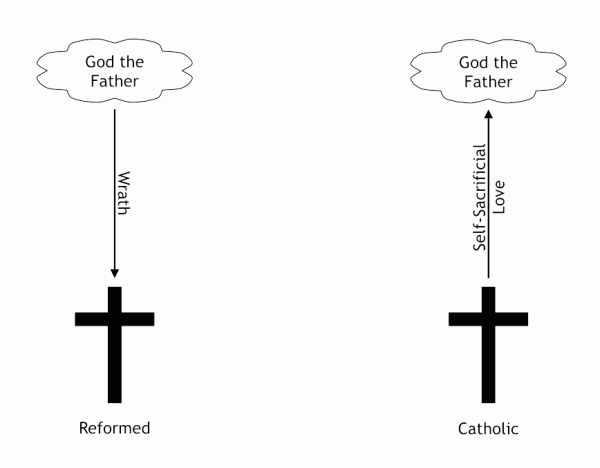
The Reformed conception of the Atonement is that in Christ’s Passion and death, God the Father poured out all of His wrath for the sins of the elect, on Christ the Son. In Christ’s Passion and death, Christ bore thepunishment of the Father’s wrath that the elect deserved for their sins. In the Reformed conception, this is what it means to bear the curse, to bear the Father’s wrath for sin. In Reformed thought, at Christ’s Passion and death, God the Father transferred all the sins (past, present, and future) of all the elect onto His Son. Then God the Father hated, cursed and damned His Son, who was evil in the Father’s sight on account of all the sins of the elect being concentrated in the Son. (R.C. Sproul says that here.) In doing so, God the Father punished Christ for all the sins of the elect of all time. Because the sins of the elect are now paid for, through Christ’s having already been punished for them, the elect can never be punished for any sin they might ever commit, because every sin they might ever commit has already been punished. For that reason Reformed theology is required to maintain that Christ died only for the elect. Otherwise, if Christ died for everyone, this would entail universal salvation, since it would entail that all the sins of all people, have already been punished, and therefore cannot be punished again.
The Catholic conception of Christ’s Passion and Atonement is that Christ offered Himself up in self-sacrificial love to the Father, obedient even unto death, for the sins of all men. The Father was never angry with Christ. Nor did the Father pour out His wrath on the Son. The Passion is Christ’s greatest act of love, the greatest revelation of the heart of God, and the glory of Christ.1 So when Christ was on the cross, God the Father was not pouring out His wrath on His Son; in Christ’s act of self-sacrifice in loving obedience to the Father, Christ was most lovable in the eyes of the Father. Rather, in Christ’s Passion we humans poured out our enmity with God on Christ, by what we did to Him in His body and soul. And He freely chose to let us do all this to Him. Deeper still, even our present sins contributed to His suffering, because He, in solidarity with us, grieved over all the sins of the world, not just the sins of the elect. Hence, St. Francis of Assisi said, “Nor did demons crucify Him; it is you who have crucified Him and crucify Him still, when you delight in your vices and sins.”2The Passion is a revelation of the love of God, not the wrath of God. The fundamental difference can be depicted simply in the following drawing:
One problem with the Reformed conception is that it would either make the Father guilty of the greatest evil of all time (pouring out the punishment for all sin on an innocent man, knowing that he is innocent), or if Christ were truly guilty and deserved all that punishment, then His suffering would be of no benefit to us.
A second problem with the Reformed conception is the following dilemma. If God the Father was pouring out His wrath on the Second Person of the Trinity, then God was divided against Himself, God the Father hating His own Word. God could hate the Son only if the Son were another being, that is, if polytheism or Arianism were true. But if God loved the Son, then it must be another person (besides the Son) whom God was hating during Christ’s Passion. And hence that entails Nestorianism, i.e. that Christ was two persons, one divine and the other human. He loved the divine Son but hated the human Jesus. Hence the Reformed conception conflicts with the orthodox doctrine of the Trinity. The Father and the Son cannot be at odds. If Christ loves men, then so does the Father. Or, if the Father has wrath for men, then so does Christ. And, if the Father has wrath for the Son, then the Son must have no less wrath for Himself.
St. Thomas Aquinas says:
Christ as God delivered Himself up to death by the same will and action as that by which the Father delivered Him up; but as man He gave Himself up by a will inspired of the Father. Consequently there is no contrariety in the Father delivering Him up and in Christ delivering Himself up. 3
There St. Thomas explains that there is no contrariety between the Father and the Son during Christ’s Passion, no loss of love from the Father to the Son or the Son to the Father. The Father wholly and entirely loved His Son during the entire Passion. By one and the same divine will and action, the Father allowed the Son to be crucified and the Son allowed Himself to be crucified.4
One question, from the Reformed point of view, is: How then were our sins paid for, if Christ was not punished by the Father? Christ made atonement for the sins of all men by offering to God a sacrifice of love that was more pleasing to the Father than the combined sins of all men of all time are displeasing to Him. Hence through the cross Christ merited grace for the salvation of all men. Those who refuse His grace do not do so because Christ did not die for them or did not win sufficient grace for them on the cross, but because of their own free choice.
A second question, from the Reformed point of view, is this: St. Paul tells us, “Christ redeemed us from the curse of the Law, having become a curse for us–for it is written, “Cursed is everyone who hangs on a true.”5How should we understand the curse, if God the Father is not pouring out His wrath on His Son? St. Augustine explains clearly in his reply to Faustus, that what it means that Christ was cursed is that Christ suffered death.6Christ took our sin in the sense that He willing bore its consequence, namely, death, because death is the consequence of sin and its curse. Death is not natural. But Christ took the likeness of sinful man in that He subjected Himself to death, even death on a cross for our sake.
A third question, from the Reformed point of view, is this: How then should we understand Isaiah 53? What does it mean that:
Surely he hath borne our infirmities and carried our sorrows: and we have thought him as it were a leper, and as one struck by God and afflicted. But he was wounded for our iniquities, he was bruised for our sins: the chastisement of our peace was upon him, and by his bruises we are healed. All we like sheep have gone astray, every one hath turned aside into his own way: and the Lord hath laid on him the iniquity of us all. .. And the Lord was pleased to bruise him in infirmity: if he shall lay down his life for sin, he shall see a long-lived seed, and the will of the Lord shall be prosperous in his hand. Because his soul hath laboured, he shall see and be filled: by his knowledge shall this my just servant justify many, and he shall bear their iniquities. (Isaiah 53;4-6, 10-11)
This means that Christ carried in His body the sufferings that sin has brought into the world, and that Christ suffered in His soul over all the sins of the world, and their offense against God. He bore our iniquities not in the sense that God punished Him for what we did, but in the sense that He grieved over them all, in solidarity with us.  That is what it means that the Lord laid on Him the iniquity of us all. He suffered the consequences of sin (i.e. suffering, grief, death), by entering into solidarity with us, entering into our fallen world, and allowing Himself to suffer in it with us, for us, even by our hands.
If one watches the film The Passion of the Christ from the point of view of the Catholic conception of the atonement, the experience is very different from watching it from the point of view of the Reformed conception of the atonement. The film is available online, in 12 parts of ten minutes each; below is the first part. Try watching it from the Catholic point of view of the atonement.

Labels