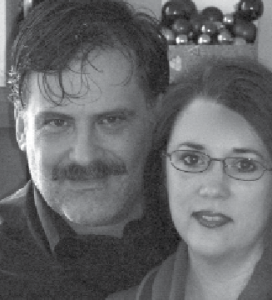
Not my best picture.... but doesn't my hubbie look sweet ?
 From Prophetess to Pope
Arthur and Teresa Beem
Arthur
In silent horror, I listened to my Seventh-day Adventist pastor’s mini-sermon as I watched blood trickle down the little Boy Scout’s leg. After crashing his bicycle, the boy had timidly approached our picnic table. In a weak, shaky voice he begged, “I lost my group. Could you catch me up to my group?” Seeing this as a “teachable moment” my pastor responded to the young lad by gently putting his hand on the boy’s shoulder.
“Saturday is the Sabbath,” the pastor said with an enlightened smile and began a short homily explaining why the fourth1commandment kept us from helping him. However, he offered to pray for him. To this day, I am baffled as to why the pastor refused the Boy Scout, unless it was the Adventist taboo of riding bikes on Sabbath. That experience symbolized my frustrations growing up in the SDA church.
As a cradle Adventist, there were so many unexplainable taboos I had grown up with. On the Sabbath we couldn’t play with the neighbors, swim, go to the store or mall; no television or radio. A sampling of the list I’ll entitle, Adventist’s Iniquities, (any day of the week) included dancing, drinking, smoking, going to the theater, eating meat, drinking coffee or anything with caffeine in it, and wearing jewelry. Drinking root beer was our family’s version of walking on the wild side (it contains no caffeine but it looks like Coke).
However, Adventists evidently believe God sanctioned imitations of evil. Adventists are well-known for their substitute meats. My mother would spend hours in the kitchen making a gray, gelatinous mass of whole-wheat gluten as fake beef. My parents would drink a hot, black liquid substance called Postum, which kids would tease was “bad to the last drop.” Any jewelry dangling from your ear or wrist or neck was scandalous, but if it could be pinned onto your blouse it was endorsed.
Adventism, to me, was not only confusingly hypocritical but scary. Some Adventist doctrines are based on the visions supposedly given by an angel to a 19th-century prophetess and one of the founders of the Seventh-day Adventist church, Ellen White. According to my childhood church, heaven opened up to her a crucial new addition to the Gospel—called the “Everlasting Gospel.” In fact, White calls it the most important message of all time2. According to her Revelation 14 prophecy, Adventists are the sole remnant of God and the 144,000. They are then given the task of proclaiming the three angels’ message (vs. 6-12).
First and foremost, they must warn the world that Christ’s Second Coming is imminent (which they have been broadcasting since 1844.) After that, the Sabbath issue dominates their doctrines. Ellen White’s messages, affectionately dubbed “The Spirit of Prophecy,” teach that very soon laws will be enacted that will force a great crisis between those who only profess to be Christians and genuine Christians. God’s dramatic test between His false and true people pivots upon which day of the week you go to church. Those who fall prey to the antichrist’s strong delusion and receive the mark of the beast are those who worship onSunday. Truly obedient Christians will become Seventh-day Adventists who attend church on the authentic Sabbath—Saturday.
The disturbing and bizarre twist to their prophecy is that Christians who attend church on Sunday3 will become the Whore of Babylon, seize national power, and enact laws that force all people to attend church on Sunday. Then in a drunken madness this spiritual prostitute will track down, torture, and kill Adventists who do not succumb to her demands of worshipping on the false Sabbath. Guess who the Adventist church claims will spearhead this coming barbarity against them? The Catholic Church. Adventists earnestly work and pray for the pitiful souls who have been deceived by Rome4.
Our SDA Bible teachers showed pictures of the pope and pointed out the “pagan-inspired, Devil’s horns of his mitre.” Using only denominationally published theology books, they warned of the dangers of stepping outside of the church. When I finally was old enough to ask a coherent question about our doctrines, I received no biblically backed answers that made sense without quoting Ellen White.
Once, on a rainy day, my neighborhood non-Adventists (but Christian) friends invited me to go bowling with them. Excited, I naively asked my mother if I could go. She shot my dad a deflecting glance, “well, ask your father.” Giving the same answer I am sure my dad was given by his parents, he responded, “I don’t think that is something we want to do.” To my inquiry of why, his answer was typical, “Ellen White speaks against it.” That was no real answer, but I had been taught to respect, or at least obey, anything she wrote. Even if my dad had personal concerns himself, which I doubt he did, he would never have breathed them aloud. He was the principal of the SDA church school I attended and not only would spend thirty years of his life as a teacher, principal and eventually an Educational Superintendent, he also would become an ordained minister of the Adventist gospel.
With my upbringing, I could easily have become like many of my SDA friends: bitter and angry. I had a total lack of spiritual intimacy with God or a church. Although I had never gotten an accurate description of who God was, in my heart I was holding out for a God of love.
Our Blessed Lord decided to teach me about selfless, passionate, intense love when I met my stunning wife in an Adventist boarding school in south Texas. He gave me the love of my life to teach me of His love for me. But it was going to take a while for God to get through. The beginning of marriage was tough. I was unbelievably selfish. But the Lord worked through my patient wife who was the consummate pantomime of the Lord’s sacrificing love. Yet still remaining in spiritual confusion, one Saturday I just stopped going to church. In fact for a while I told my wife I did not know if I could even believe in God.
In my thirties, I finally came to my own personal age of enlightenment. I had gotten to the point that I wanted some answers, not just for myself but for my young children that were looking to me as their father and priest of the family. And, like before, I received none through the SDA church.
My uncle David founded a Biblical Research Institute that recorded eschatology studies on audio tape. At the time I was doing sales on the road and would listen to several of the tapes each week. Some of his research was truly profound and listening to these tapes showed me that there might be another way of reading the Bible. Ellen White just may not have known what she was talking about. In one tape, “The Law,” David’s systematic explanation of God’s law in Scripture was the first time I realized it was based in love. God’s law was not a tool to kill you with but a tool He fulfilled to save you. I was struck like a lightning bolt. I had to pull over to the side of the road because I was weeping so profusely.
After this lightning bolt, I started to read C.S. Lewis’s Mere Christianity and A.W. Tozer’s The Pursuit of Man. I never knew that there was flesh on those old dry bones of religion. For the first time, between my uncle David, Lewis, and Tozer I earnestly studied spirituality. It was like these writers poured the wine of the Eucharist upon my tortured mind and it exploded to life. As God’s grace was transforming me, my wife had reached the same point but from a completely different direction.
Teresa
It was as if, until that moment, I had been a merry, floral-crowned damsel tossing rose petals through the air as I skipped through my Pre-Raphaelite, bucolic life—when I was hit by a Mack truck. In shock, with my emotions plowed into the ground, I pondered how my whole life had been a lie. But then the thoughts turned even darker; my parents’ lives had also been based in fiction. Then the circle grew wider—my grandparents, my teachers, my pastors. Oh, it was just too painful to even think about.
You see, I loved serving my precious Jesus through the Seventh-day Adventist church. My family had been part of this church for so many generations we were not sure when they had been converted. In fact, we had become cultural Adventists or cafeteria Adventists—who would pick and choose the doctrines and rules we personally believed and roll our eyes at the rest.
Our family were the “cool” Adventists. We openly drank Dr. Pepper to the gasps of the orthodox, and watched Disney movies—in the movie theaters. (I was told by my teachers that I would be in trouble if I mentioned that fact in school.) You would see our family eating out at a restaurant every Sabbath. Though we wouldn’t have thought of leaving the church, our family had proudly thrown off the shackles of what we considered silly, hypocritical teachings. Oh, I don’t want to mislead you. I still believed that Jesus was coming soon and looked for evidence of it in every newscast. Sincerely and earnestly I had wanted to be obedient to Christ and I assumed keeping Saturday as Sabbath was keeping His commandments. With all its blemishes, I was proud to be one of God’s chosen people, part of the remnant spoken of in Revelation. After all, it made one feel special to know that one’s denomination was God’s elite.
Because I was an “enlightened” Adventist, I saw myself as the future of the church and was devotedly active. I sang in the choirs, wrote for its publications, taught in its schools and Sabbath morning study groups. Then, in the mid 1990’s, life had become busy as a homeschooling mother of three and time with the Lord in prayer and Bible study had dwindled. For the first time in my life, new temptations doggedly pursued me. I felt God calling me back to Scripture, but once there, the illusion of my life and my worldview of truth was shattered. There wasn’t a shred of biblical evidence to support Adventist unique doctrines. Adventists had woven texts into Ellen White’s prophecies, rather than build doctrine upon the Bible alone. It wasn’t that I hadn’t read the Bible before; indeed, I could win any biblical trivia game I played. It was confusing. I stomped the ground in a tantrum to God and reminded Him that as a good Protestant I knew Scripture by heart. I knew Scripture… I knew Jesus, He was my best friend! “Don’t change the rules on me now.” Yet knowing my yearning for truth, God lifted the veil from my eyes and showed me that I had been living in delusion. I could see for the first time how Adventist doctrine was not just wrong, but even spiritually dangerous.
No matter how painful it was to tear myself from my culture and indoctrination, I knew I could no longer support a church—as sweet and well-meaning as it was—that taught beliefs that were not based in authentic history or Scripture, that taught spiritual fear and elitism. So, I went to my husband to break what I thought would be horrifying news.
Arthur and Teresa
Sitting staring at each other, we both were thinking the same thing, “How do I say: ‘Honey, I don’t think I’m an Adventist anymore.’” God gave us the grace to tear off our religious facade and words began to pour. We had never spoken so candidly about our spiritual life. We went from parallel paths to one miraculously united with Christ.
In 2001 we formally placed our resignation letter on the desk of our pastor. As we left his church office, Arthur’s hand steadied me for I felt a bit faint. My life had just fizzled away quietly like a wet fire cracker. There was no wake, no funeral, and no public grieving for my loss. Yet, in that moment Christ ignited a new spark that would later turn into a bonfire of joy.
Arthur felt pleased we had made a gracious and respectful break. Even more, he was startled at his feelings of exhilaration—like fleeing a dry desert for the ocean. Since we lived in an Adventist community Arthur did detect some guilt thrust in his direction by the condemning gaze of Ellen White in the eyes of some church members. He missed by inches the brushes that were attempting to paint a “scarlet A” (in this case meaning “apostasy”) on his chest. In apologetic desperation, I stayed close to my family and friends vainly attempting to prove to them we had a basis for leaving.
Soon we were eagerly worshipping and studying with other Protestant denominations, so happy to be awash in our newfound brothers and sisters in Christ. Within a few months we began to discover a real problem in choosing our own church. Oh, it’s easy if all you are looking for is an inspirational service. There are so many wonderful, joyful, and fulfilling communities of Christ to which you can feel like you belong. (I just left one!) The problem comes when you want your church to be based in biblical truth. We had spent a lifetime dedicated to a church who had indoctrinated us into fiction, so we were understandably hesitant to repeat that same mistake. Fearing deception, we spent years grilling pastors about their doctrine.
Every single denomination out there claims its beliefs are the most Bible-based. One pastor proof-texts infant baptism, while the pastor down the road proof-texts adult baptism—quite confusing. Theologians dueled with the original languages claiming that really, if we could read Greek, the Once-Saved-Always-Saved position would be ridiculously clear or just ridiculous—depending on which scholar we asked. One pastor with two Ph.D.’s in theology insisted that if we could, “acquiesce to neo-orthodoxy’s ontological and soteriological exegesis of justification through the feminist theological worldview we would become at peace with our post-modern epistemological quest.”
I looked at Arthur and whimpered, “what?” Then we went home and sent off for applications to all the different US seminaries. We decided, in order not to be deceived we had to be able to read the Scriptures in their original form. Arthur and I became consumed with theology. It seemed the more we knew, the more we realized that it would take every second of every waking hour in theological study for the rest of our lives to begin to know all this stuff. …Wait… I had to take a shower …and fix dinner… and phone my mother…I was running out of time! It was devastating to realize that to really avoid deception and know truth, we would have to be… God.
The thought terrified us. My Protestant friends all told us to relax, all we needed to understand Scripture was the Holy Spirit. Yet, we knew there were false prophets (Ellen White!). As sincere Christians, how could we guarantee that we would not fall prey to false doctrine again? Had God abandoned us to correctly, infallibly interpret Scriptures with nothing but our average IQs?
God sent a Catholic friend to introduce a revolutionary idea. He cut through our despairing cloud of confusion with a new inquiry. “Perhaps you are asking the wrong question. Maybe, just maybe, instead of finding what you think is perfect theology, try looking for the church God set up as His authority.” That haunting statement changed our lives as we took it to Christ in prayer and study.
For years, we had watched an online Catholic-Protestant discussion group, but we had dismissed the Catholics’ defense of their faith because it was too biblical. We thought it was just another plot of deception. We had been warned about online Jesuit plants—tricky papist spiders—drawing the web into their ultimate antichrist designs. We purchased a Catechism to find out if the tricky papists were lying about what Catholics believe. After all, what they were saying wasn’t what we had been taught they believed. Yet there they were! Catholic beliefs! Just as the Catholics claimed—in the Catechism, the Catholic Encyclopedia, history books, and everything else we could get our hands on to read. So Arthur and I immersed ourselves in our new quest of discovering real Catholicism.
As my husband and I began reading the early Church Fathers, we were shocked at how Catholic they were. Could it be Catholic corruption had already been trickling in before the Apostles died? But that cannot be right, can it? These early writings were not just by any convert; these were writings by bishops who had been taught by, anointed by, and chosen by the Apostles themselves to lead the churches they started. That just didn’t seem to make sense that they would have become apostate so soon. If God had abandoned His Church so quickly after its inception, then we really have a problem because we can’t trust the Trinity doctrine, the canon of Scripture, or the divinity of Christ because these were the men (and later Fathers) who defined these doctrines and who attested to which writings were by the apostles and which were forgeries.
So we either had to believe God protected His Church’s theology, or we have to cut the Church off right after its birth. Is it possible that these godly men, who were martyred for their faith, could have gotten it that wrong? In the end, we had to admit, that their writings didn’t actually conflict with Scripture; their writings were in conflict with our personal interpretation of Scripture, or rather I should say, the way we had been taught to interpret it.
After acknowledging Adventists had disseminated error about Protestants, it was not impossible to accept the idea that Protestants disseminated error about Catholics. Christ was now opening up a frightening, exciting, new worldview of Christianity for us.
It was about this time that Arthur and I published a book called, “It’s Okay Not to be a Seventh-day Adventist” (Amazon.com). It lays out the history and doctrine of the Adventist church, comparing and contrasting it with Scripture and supporting former SDAs in transitioning into mainstream Christianity. After leaving that church, we had been contacted by numerous hurting Adventists who needed someone to whom they could talk. Many were terrified of Ellen White’s last-day prophecies and were afraid to go to other churches for fear of being deceived. Since we had been down that same road, we could sympathize. So God handed us a ministry for them.
As the book was announcing to the SDA world that we had left Adventism, we had a new announcement they would find even more horrifying. We had finished the RCIA program and now, after intense study, we were entering the Catholic Church. Not that we understood the doctrines perfectly, but we began using an acronym, BEAU, believing that if every other doctrine within Catholicism wasn’t true, it just didn’t matter if they got these things right. (Now, we are discovering all the other doctrines, including Marian Dogmas are not only breathtakingly true, but biblical.)
BEAU (the French male form for “beautiful”—apropos for Christ):
BIBLE: We were shocked to discover that for 1600 years the Bible was more extensive; that Reformers took out unwanted books. Contrary to Protestant teaching, the Catholic Church protected Scripture with her life, copied, translated and transmitted it. We realized that Sola Scriptura was not biblical but was a Protestant tradition and that the Bible actually points to the apostles and the Church as the foundation of truth (Eph. 2:20, I Tim. 3:15).
EUCHARIST: We eagerly embraced the clearest scriptural meaning that God’s body was actually miraculously present in the Holy Communion endowing us with special grace. Coming before Him at mass, experiencing the love at the cross, becoming one with Christ through the Eucharist, we delighted in knowing these things are not figurative, not just a symbol, but really living the Kingdom of God.
AUTHORITY: As we analyzed our culture, we saw the crumbling of western society because of the lack of authority. The rebelliousness of children, divorce, sexual promiscuity, abortion—at the root, all are a rejection of God’s sovereignty. Nature attests to a hierarchy of leadership; Israel was structured around their appointed authorities; is it possible we had missed this in the New Testament? Again, we had been blind to an obvious part of Scripture. Repeatedly the apostles command Christians to submit to God’s appointed authorities even when they were less than perfect.
UNITY: Finally, as we read Jesus’ fervent desire that His disciples remain unified, we recognized there was something distinctly unscriptural about all the different denominations. Scriptures did not allow for sects. Christ stresses unity more than many doctrines Protestants deem “essentials.” Indeed, unity is an essential of faith. We had to ask ourselves if Protestants had a biblical basis to break with the Church. The answer was no.
It is difficult to express our duality of grief and exhilaration in the first two years of being Catholic. We have learned obedience to Christ brings unfathomable joys. There is no honor in heaven or earth like giving undying fealty and faithful love to the Savior and His Bride. It is thrilling to be a part of this historical, triumphant Church.
God has given us many surprises. Becoming Catholic has improved our marriage. Through participating in the Eucharist, we have gained a penetrating insight of the privilege of sacrificing for our spouses. As Christ broke Himself for us, we then also give of ourselves, fully, unreservedly, tenderly to our spouses. Our rights fade away in the glory of offering ourselves to each other.
We have understood our own irreplaceable importance to God as we study the Catholic Church’s doctrines on life and birth control. No longer are we, as we felt in Protestantism, an army of one. We find great relief as we drink from a vast two-thousand year reserve of living water from the immovable Rock that Christ founded upon Peter and the Apostles. We relish the safety of the Church’s treasury of faith and communion of saints. We delight in knowing that God is changing us from glory to glory and erasing the original sin that stained our souls. Pain no longer elicits confusing questions of offending God: now we lift up our sorrows in redemptive suffering. We no longer fear other Christians nor do we see ourselves pridefully as God’s elite.
And yet our decision to follow Christ into the Catholic Church has left our Adventist families heart-broken, fearing for our sanity and with some, even worse, believing we are traitorous to the Gospel. We humbly ask your prayers that one day our families’ hearts will be open to this blessed of all faiths. For truth heals the deep pains of false beliefs. We thank each one of you who faithfully prays for unity and for little straying lambs, like we were, to find our way home into the Roman Catholic Church.
Arthur and Teresa Beem were both raised in the Seventh-day Adventist Church and attended their schools from elementary through the University level. Arthur is a travel nurse and Teresa writes as she travels with him. Their three college-age children are on the East Coast, way too far from their parents who are currently in the state of Washington. The Beems attend the beautiful St. James Cathedral in downtown Seattle. They run a ministry for former Adventists and would someday love to be involved in the RCIA program helping other Protestants to understand the beauties of the Roman Catholic church.

